
For culturally relevant and sustaining education (CRSE) to spread and thrive, we need to see what it looks like in action.
Not just the highlight reel or the end product. We need to see all that went into bringing it to life: the challenges, the pushback, the steps forward and steps back.
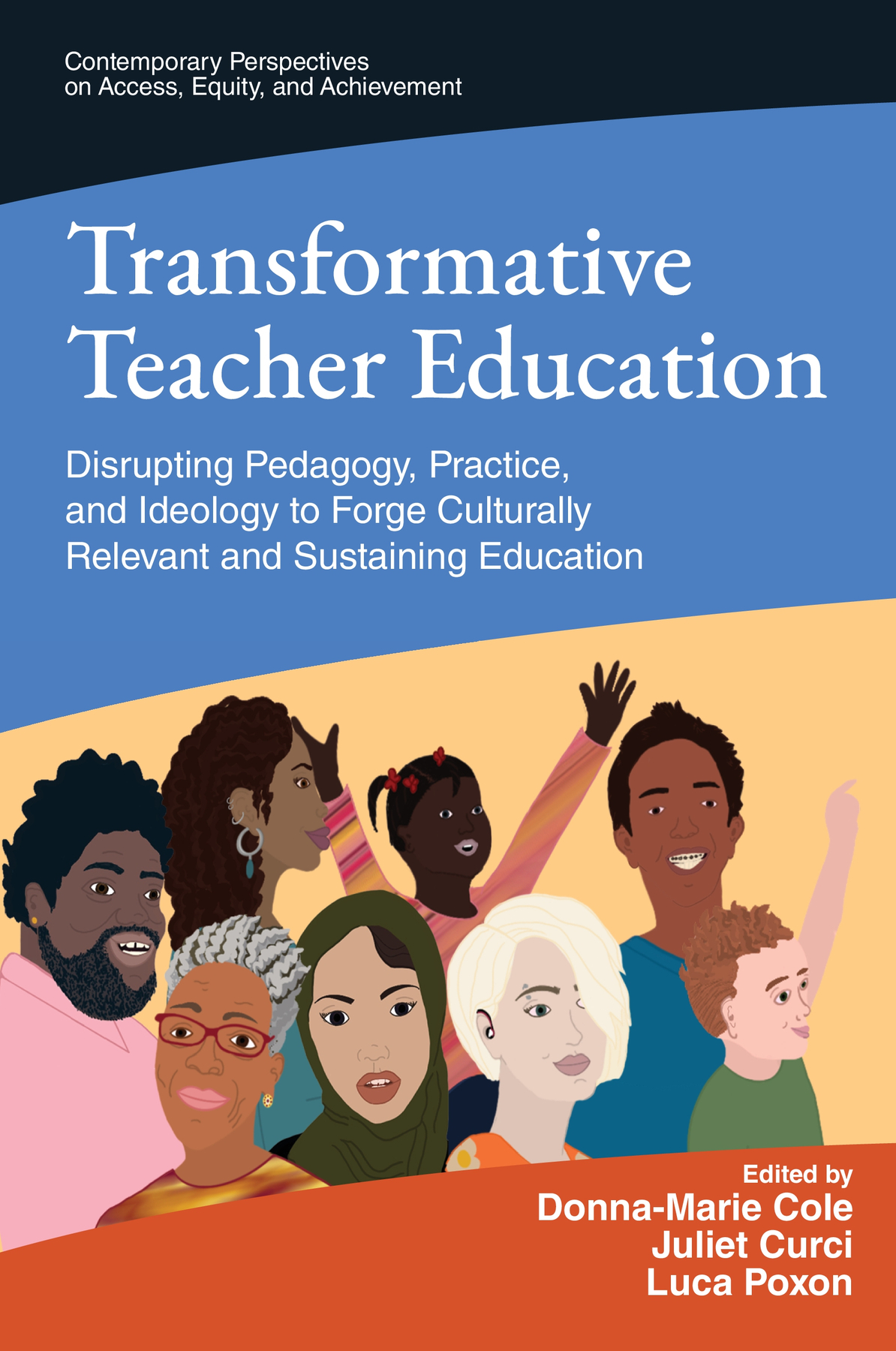
A new book, Transformative Teacher Education: Disrupting Pedagogy, Practice, and Ideology to Forge Culturally Relevant and Sustaining Education, does exactly that.
The book gathers the accounts of more than twenty faculty members across more than a dozen Pennsylvania institutions of higher education who set out to embed CRSE into how they prepare teachers. It shows what it takes to truly implement CRSE in schools across the commonwealth, offering a behind-the-scenes look at the process from those who have already gone through it.
We are proud that members of the PA Educator Diversity Consortium (PEDC) played a key role in bringing this book to life, especially co-editors:
The book started back in 2022 when—with funding Temple University received from the William Penn Foundation—Donna-Marie, Juliet, and Luca convened a community of practice for Pennsylvania teacher educators who wanted to integrate the CRSE competencies into their courses. That first year produced the CRSE Repository, a collection of original and revised course syllabi along with program elements, reflections, and artifacts that detail why and how teacher educators integrated CRSE competencies into their work.
The group continued to meet, laboring over what was working, what was not, where they were meeting resistance, and what they needed from each other. It was clear the conversations happening were important and needed to be shared with a larger audience.
Why Now
Four years later, the work is harder to do publicly than it was five years ago, making Transformative Teacher Education more important than ever.
Because despite the challenges, the people in this book did it anyway.
"I think it's important for folks to know that people are still doing this work and people are still committed to caring about and addressing the needs of young people in school even though the work is under attack," says Donna-Marie.
The team found that nearly all of the available literature on CRSE was written for K-12 classrooms, which leaves a massive gap: what about the people preparing those teachers?
"Much of the literature that's available on culturally relevant and sustaining education really has a strong K-12 lens, and so meeting the needs of people in teacher preparation in particular was something that we were really striving to do," says Luca.
Juliet saw this firsthand. Twenty years ago, she was a graduate student at Temple teaching a course on lesson planning, and she noticed who those lessons were being written for.
"When I was instructing the students in this class around teaching a lesson, it was for this amorphous sort of unidentified, uncultured set of students. And so the teacher education students were supposed to think about writing hypothetical lessons for a set of hypothetical students who are also very generic."
But generic is never actually generic. She said it often leaned — whether explicitly or implicitly — toward white, male, heteronormative, Christian, middle class, whose culture is considered to be the default.
With these biases so deeply engrained, this is not something that can be fixed with a quick diversity unit added into the semester. It requires a different starting point, one where, as Juliet says, teacher education is “about an acknowledgment of the beauty, opportunity, and challenge of humanity's diversity.”
The Transformation
Donna-Marie points back to the first CRSE competency, Reflect on One's Cultural Lens.
"There's this strong belief that you can't do this work unless you know who you are, unless you understand your own connection to the work, your own connection to the world. The transformative piece is about transforming yourself, your way of thinking, the things that you read, the way you think about the work."
Luca sat with the chapter authors through round after round of revision, reading drafts that were still raw.
"There's something about being trusted to bear witness to other people's vulnerability that is so humbling. I sometimes couldn't believe that they were letting me read these things. But they did. Being able to witness that, to be trusted, made me feel kind of cracked open and see how much I still have to learn."
For Donna-Marie, who came to the United States from Jamaica and moved through schools where nobody named what was possible for her, the process of creating this book gave a sense of pride she wasn’t necessarily expecting.
"To see some of my colleagues who have contributed to the book, who are white women, really sit and tough out some of these ideas about how do I transform my syllabi and how do I transform myself, I feel proud of them, and I feel very much happy for the students that they are teaching. For me, it's personal. It's emotional."
Juliet holds herself to the same standard she asks of readers, which is the tone the whole book runs on.
"I want all learners to be able to access culturally rich, affirming, dynamic and challenging educational environments. And I also know that I have fallen short in providing those environments."
If You Are the Only One in the Building
Plenty of readers will recognize a version of their own situation in the authors’ experiences, especially the feeling of isolation.
"Many of the authors were from institutions that were not supportive of their work, or where they were the ones operating and doing this," Juliet says. "That's why they found such value in the community of practice. Being able to have some space to receive validation and to know that they weren't alone, and that there were others who care and are doing this continually despite the challenges."
The book addresses the threat of isolation by sharing:
Donna-Marie's advice for those readers is not to wait for permission.
"This is not a job. This is a passion. You can still continue to do the work. You can still build community. You can still find spaces outside of a place that is unsupportive to continue to do the work. And the work just looks different in different spaces."
What's Next
Luca hopes that “people who read this feel some hope that no matter where they're starting from, there is something that they can do, and that that matters, and it is totally worth the effort.
“Tweaking language in a syllabus, reframing how we talk about certain things. These small things that may not take up a lot of time can have really significant results,” he says.
Juliet is already looking past the book, toward more communities of practice, more institutions, and a national conversation about what Pennsylvania has figured out.
Donna-Marie wants people to walk away knowing they can do this in their own schools and communities.
"Folks have different entry points into the work. Some folks are way more advanced and other folks are just entering the conversation,” she says. “So there is a space in this work for all of us, for everyone.”
Learn more about the book and read excerpts at transformativeteachereducation.com. For bulk order discount codes, contact Luca Poxon at luca.poxon@temple.edu.
Whether you’re looking to learn more about our initiatives, need assistance, or just want to connect—let's talk. Your questions and feedback are important to us, and we’re eager to hear from you!


